Category Archives: Cookbooks, Magazines (+recipes from)

Fougasse: White Bread Glee

Chewy Good Times

Easy. Impressive.  Can be hooked on the end of your bike handlebars.  These chewy, pretzel-like loaves are my new Gleedom.

I mean, look at them!  (let me show you an overhead.)
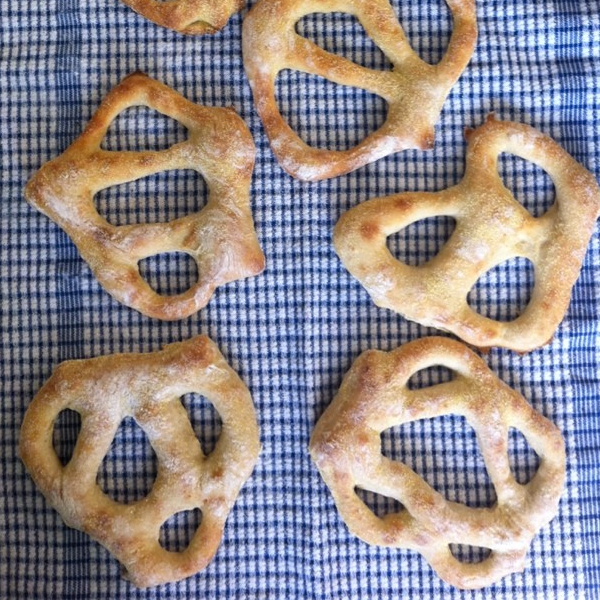
They multiply like rabbits, be careful.

The Fougasse first caught my attention in Dorie Greenspan’s Around My French Table where she explains that this Provencal-style bread should be eaten warm and with simple food,  like some saucisson and a glass of rosé.  Ideal for picnics.  And guess where I took mine?  On le picnic.  Man, sometimes my French instincts overwhelm me.

The recipe I actually used came from the book Dough by Richard Bertinet which has the Fougasse on the front cover. Most importantly in the book Mr. Bertinet said this was easy to make and would impress people.  Well, who am I if not someone who wants to impress with the least effort possible?
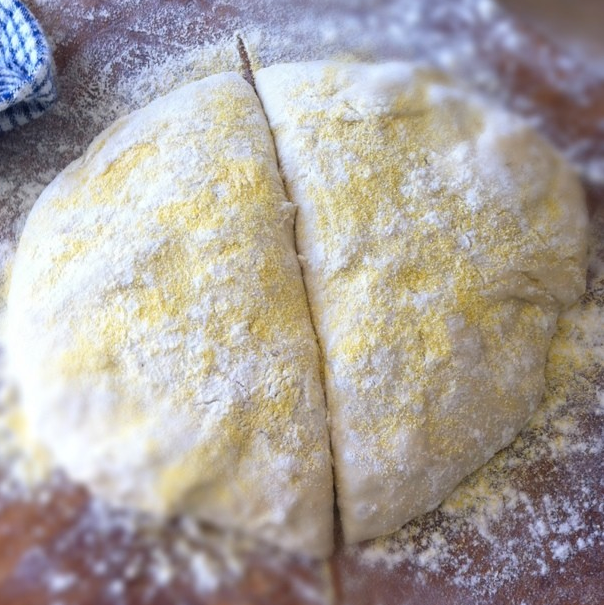
Cornmeal dusted dough

You start by making a simple white bread dough (yeast, bread flour, salt, water) and letting it rest for 1 hr until it doubles in size.  My dough took longer, maybe an hour and a half, perhaps the kitchen was a bit cool. Then you gently plop it on the counter-careful not to deflate it–and let it rest another five minutes.

Using your bread scraper you cut the dough in two (and giggle to yourself because it looks like a bum!).

And then into 6 pieces.

Baby Fougasse.

You then take each piece of dough and use the edge of your scraper to make a few diagonal cuts through the dough.  Which you then “fan out” with your fingers.

You Must Be My Lucky Star

You can also keep the dough rectangular and make parallel cuts and pull them apart to make a “ladder” shape.  Fewer holes are better because as the dough bakes any small holes will close up.  Obviously I am far (but pretty close) from being a master at this so I did most of my fougasse with only three cuts.
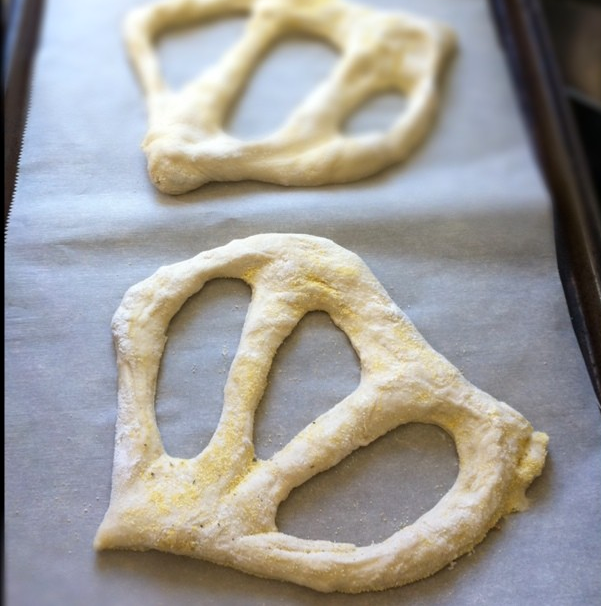
Ready for heat.

Now take your fougasse and pop them on a baking tray (or a wooden peel if you have one so you can slide it onto your baking stone already pre-heated in the oven 450 F).  I baked mine two at a time on a tray.  You can also press olives, or herbs into your fougasse at this point.

I did use a spray bottle to spritz some moisture into the oven before I shut the door to help get a nice crust on the bread (steam helps crust up the exterior and keep the interior soft).
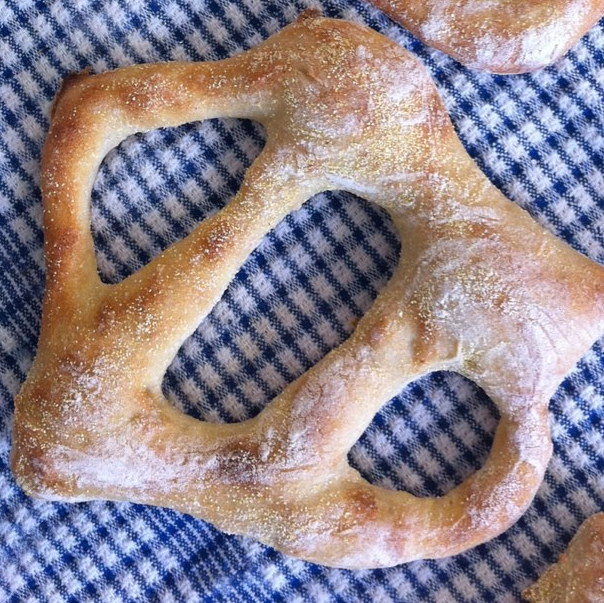
Tear apart and eat.

Et Voila!  12 minutes later a delicious picnic snack.  Just wrap them in a clean tea towel and go.

(Would also work as tasteful accessories for a meat dress).

1 Comment

Filed under All Recipes, Cookbooks, Magazines (+recipes from), Ruminations on the Edible

Gwyneth Paltrow is GOOPing on my territory

My mouth is a bit smaller than in this picture.

First the acting, then the singing, next a cookbook and now a blog post about cheese. I’m exhausted GP.  You don’t have to do everything.  Let me do the cheese- seriously.  I mean, really…what else do I have?  A small film called Salami Heaven, songs at pre-school where I keep my voice low enough to blend in with the hum of the fan and a kick-ass recipe for fudge.  But no cook book.

All I had was the cheese.  And now you had to go there.  And I had to go there to get the link to your post. It’s just unjust.  But, it is kind of a good post.  I grudgingly admit.

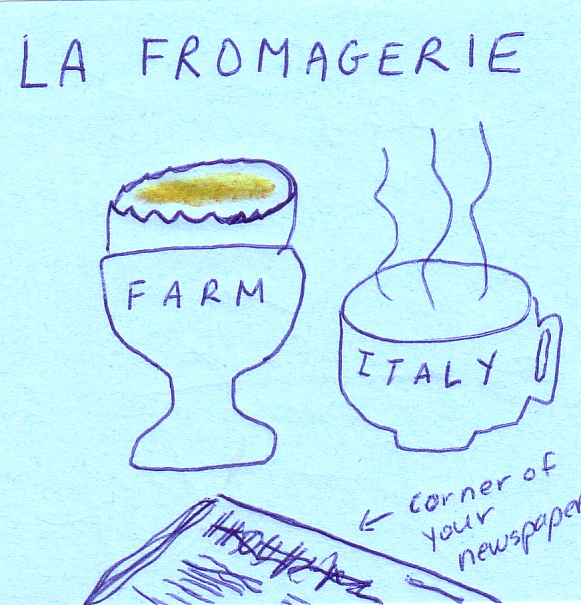
And I do love, love, love (love) La Fromagerie in London, and their cheese room and their soft-boiled egg for breakfast with the imported Italian coffee.  And nothing bad to say about Murray’s cheese in New York either.

The newspaper is for when you eat breakfast alone-- which is the best way to dine in the early morning.

Just one thing, I resent the “cheese is kind of unhealthy” disclaimer off the top.  At its best, made with care and with pristine milk I would consider it pretty darn healthy.  And btw, so does Patricia Michelson, owner of La Fromagerie.  A quote from her first book, The Cheese Room (personally autographed–(ha GP!)– to my husband… but details..),

“Who would have thought a book on cheese would contain a beauty tip? Not such a daft idea as we should all know about the health enhancing qualities of cheese–good for teeth and bones as well as the blessed dietary attributes of Parmigiano Reggiano for young children, women in pregnancy, the elderly and sporty types.”

She’s talking about the fact that Italian scientists have studied the benefits of Parmigiano-Reggiano for many years. It is easy to digest for children (and people with gastrointestinal problems) as the long ageing process slowly breaks down the milk proteins. It has high levels of calcium and phosphorus making it very good for people suffering from osteoporosis.  Plus for athlete’s it can provide the protein they might get from meat, but is lower in cholesterol and generally one of the lower-fat cheeses.

BTW, Patricia’s books are wonderful and fun to read, not only if you love cheese but if you enjoy food.  And if you’re in London, you must absolutely head to her store.  Even more important than a visit to Top Shop,  afterall,  you can dress in cheese, but you can’t eat clothes.

3 Comments

Filed under Cheese/Cheese Related, Cookbooks, Magazines (+recipes from), Strange but Tasty

Woman discovers that Martha Stewart can bake

My latest discovery-hot off the press in 2005

Yes, I know, next I’ll be gushing about a great new dish called “Miso Black Cod” or enthusing about that new gadget called the “electric mixer”.  After many years of having Martha’s Stewart’s Baking Handbook in my amazon.ca cart I finally pressed “check out” and bought it.  My amazon purchases are strange in that things like this cookbook which I could have been referencing for years I feel guilty about “splurging” on but The Wild Sweets dessert book (as awesome as it is) I order without second thought though I have yet to make an Ice Wine Foam.

But-in case it’s been around so long you’ve forgotten about it–let me reintroduce you.  It’s got General Baking Tips (read a recipe all the way through–how guilty am I off not doing that–oops- I need lavender petals?), explains general baking techniques  such as how to add a drop of lemon to your caramel instead of wiping down the sides of your pot to prevent sugar crystallizing or shows pictures of the stages of whipping egg whites (there should be a wallet size pull-out of that.)

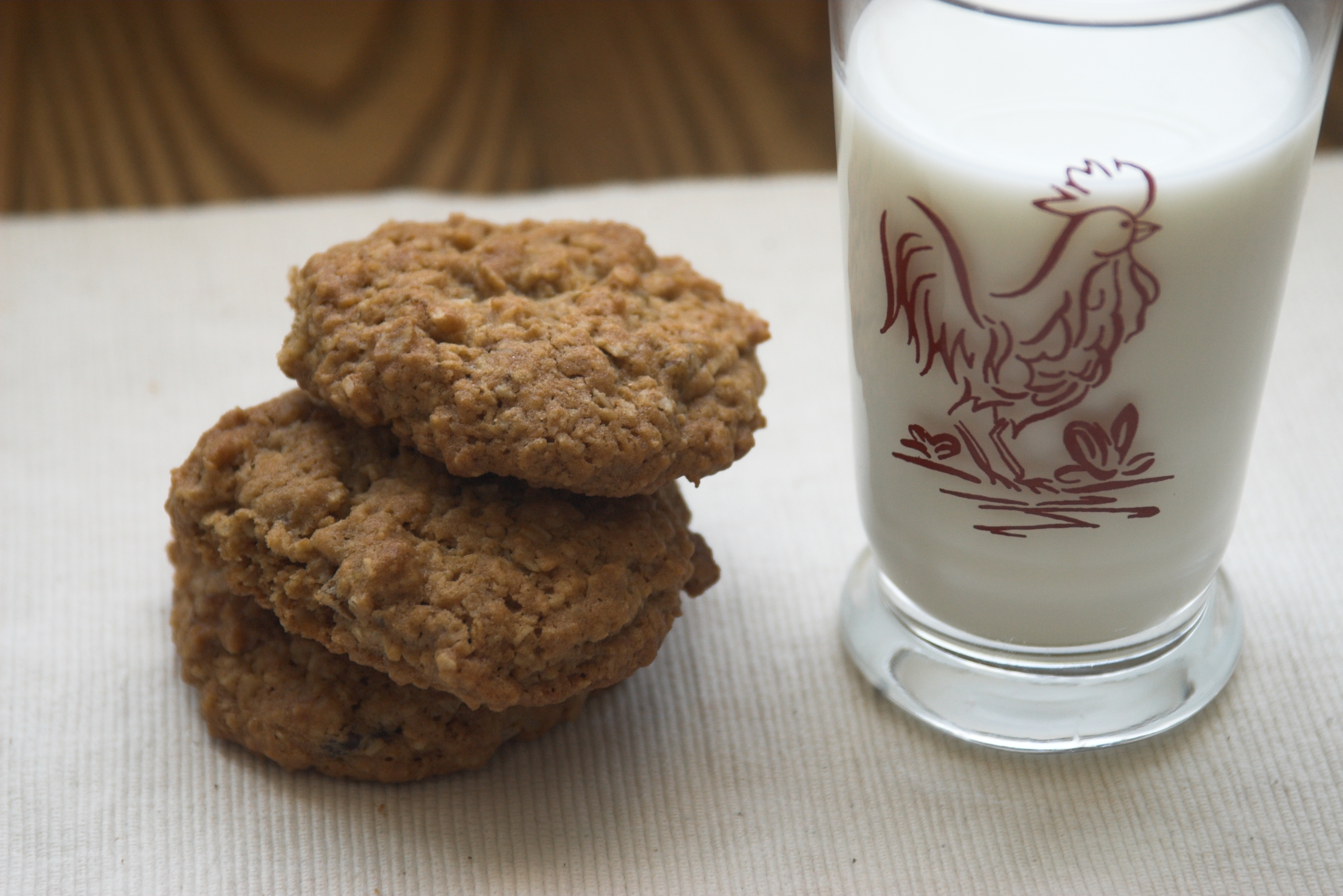
Chewy Crispy Cookie-ness.

It just has a whole whack of amazing recipes that are well-written, well explained and look gorgeous (as you would expect).  But doable.  Devil’s Food Chocolate Cake with Mint Chocolate Ganache, Potato and Onion Tarte Tatin and a zillion amazing cookies that would make most mom’s hate you at the Bake Sale.

The package arrived on a Friday.  Saturday morning at 7am Felix and I were ready to bake.  (Well, we were up so why not–plus I love baking in the early morning).  We went with the “yep, I have the ingredients” recipe.  Chewy, Oatmeal Raisin Cookies.

7:30 am. My work is done.

We ate a bunch of dough raw, we had a few incidences of small hands near a whirling mixer and much impatience as we watched them flatten in the hot oven, and a toasty sweet cookie aroma filled the kitchen.

Get thee to a cookie jarrery.

Now imagine these with an Ice Wine Foam.

2 Comments

Filed under All Recipes, Blogs with cooking tips, Cookbooks, Magazines (+recipes from), Ruminations on the Edible

Woman has no shame: makes Christmas Stollen at Easter

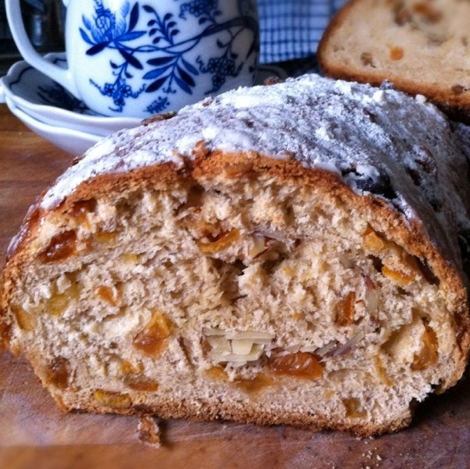
“Merry Easter” Stollen

There’s no time like Easter for Christmas Stollen I always say.

My mom always makes a Czech Easter bread for the holiday called velikonoční bochánek and so I thought I would try a different festive fruit bread. What I discovered just this year (post Stollen making) is that the bochánek  is actually the same bread as the Christmas vanocka–just a different shape!   So can you really blame me for making Christmas stollen in the Spring?  One size fits all holiday breads are in my blood.

Luckily, all’s well that ends in rum-infused fruit bread.  I took my recipe from the The Bread Baker’s Apprentice. (p252) After much grumbling, this apprentice realized that the only right thing to do was to candy my own oranges to make a pure Easter stollen.  So we’ll start there.

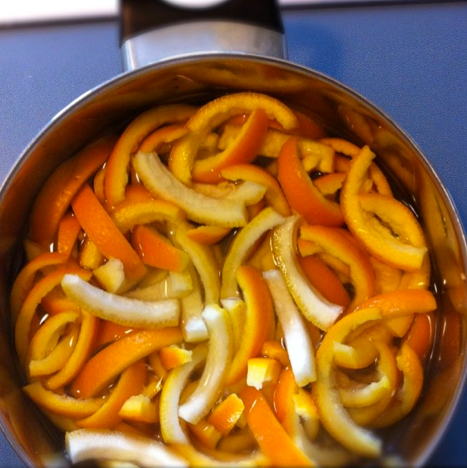
Boiling the bitterness from the peel

Truth be told, candying citrus peels is one of those things that seem like a monumental pain (like laundry) but then you realize “Hey, I’m not washing clothes on a washboard in the river one garment at a time, I have a washing machine with steam setting.”  Essentially you peel your oranges, pith on, slice them into strips and then boil them for 3 minutes and drain (repeated 3 x) to remove their bitterness.

Wiping Down Sugar Crystals

Then you melt  sugar and water over medium heat (1 1/2 :1 ratio) essentially making simple syrup. Add your orange peel and wipe down the sides of the pot to flush off any undissolved sugar crystals to avoid crystallization later on.

Bring to a boil and then reduce to a simmer for about 1 1/2 hr or until the syrup has reduced to a quarter of the original quantity.

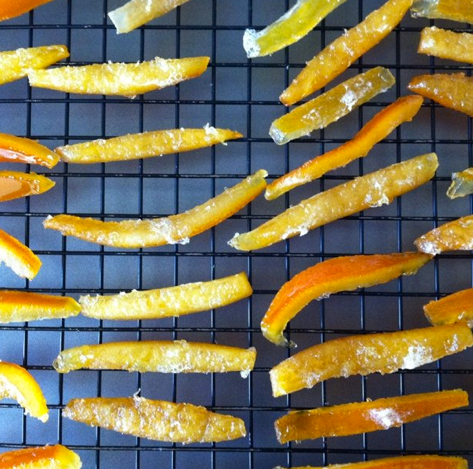
Candied Orange Peel ready for action

I put these on a rack to dry a bit before I diced them.  This is the point you could also roll them in sugar and dip them in chocolate, or store them in their syrup to use later.  (You can use the syrup to sweeten drinks or pour on fruit).

Let’s get to the STOLLEN (but first some raisin time) :

Candied orange and raisins soaking up a little Cointreau.

Take 1 cup raisins and one cup of the diced, candied citrus and  soak overnight in brandy, rum or schnapps.  I had Cointreau so I used that and eliminated the addition of citrus extract.

Next you make the sponge which will leaven the dough.  A simple combo of whole milk, AP flour and instant yeast.  I didn’t have whole milk so used 2% and a little bit of cream.

The sponge after fermenting about 30 minutes.

When the sponge is ready, you mix together the dry: flour, sugar, salt, orange and lemon zest and cinnamon.

And in a stand mixer on low speed (using the paddle attachment) add the sponge, an egg, butter and some warm water.  When the dough is combined you let it rest 10 minutes.  Then add in the fruit and finish kneading it in with your hands. The liquor-soaked candied fruit actually helps preserve the bread–if soaked a few days in advance it can help keep the bread for weeks. (Perhaps this was the fairy loaf that sustained Frodo in his journeys–those fae are clever with dried fruit!)

Stollen fermenting patiently.

You then cover the dough in a lightly greased bowl and let it sit for about 45 minutes to rise.  Then you can use one of two methods to form the stollen.  The method that looks cooler (and more like the blanket swaddled baby Jesus which the bread is meant to represent) or the easier loaf method which causes less cursing (and who wants to curse an edible baby Jesus) which was my choice.

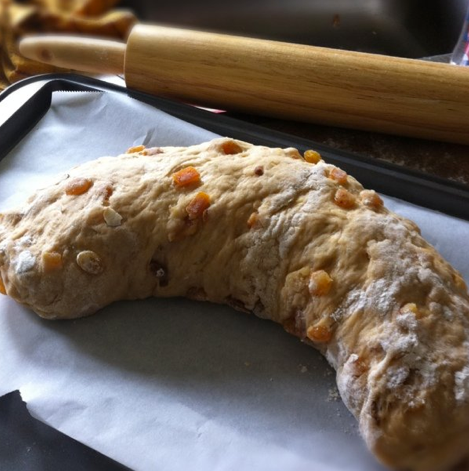
For either method you flatten the dough into a rough rectangle and cover with sliced almonds and extra fruit.  You can also replace the almonds a layer of marzipan which I would do next time–I think it would add a nice moist core.

Send in the almonds.

Then you let the stollen proof for about an hour.

Proof: I made Stollen.

And finally you bake at 350 F. I baked it about 55 minutes (you can make two small loaves but I did one large) until the internal temperature was 190 F.  (hey, I wanted to get this sucker right!).  But in hindsight I would have probably taken it out sooner knowing it will still bake a little before it cools.

This won’t hurt a bit…

While it’s still warm, you brush the bread with oil and then cover with a sieve of icing sugar.  Repeat again.

Voila! Can I shake the sugar or what.

And then eat!  Lovely with a cup of tea.  Apparently the Germans like to let the stollen sit out and dry up a bit.  But maybe that was just an accident once upon a Christmas and they don’t want to admit it and now it’s a bad, bad tradition.

Or maybe they just like an excuse to “Dunk”.

Leave a comment

Filed under All Recipes, Cookbooks, Magazines (+recipes from), Ruminations on the Edible

Best Pasta Carbonara ever-unless you live in Italy and own a bunch of hens

A delicious shadow of its true self.

I took this pasta carbonara recipe from the March Cucina Italiana magazine and massacred its local, farm-raised, artisanal integrity in so many ways that I feel dirty.

So dirty that I’m baking rosemary focaccia bread in the oven as penance to Italy itself (I had to use a big tray).  The fresh baked smell of herbs and crisping crust is making me feel slightly less like a charlatan for even attempting a local dish that uses the freshest of fresh ingredients-eggs pulled from the hen’s butt with one hand while the lemons are plucked off a lemon tree with the other. Did I mention the almost extinct Cinte Sense pigs which provide the pork?  Check out the whole story which will make you want to gnaw on a piece of pancetta ASAP.  Materie Prime by Douglas Gayeton.

The good news first-if you didn’t know–true pasta carbonara does not include cream so it practically falls into the health food category.  Sure there’s the pancetta and I suppose a whole bunch of  cheese but truly–once you ammortize the fat over a few helpings it’s negligible.  I’m almost positive.

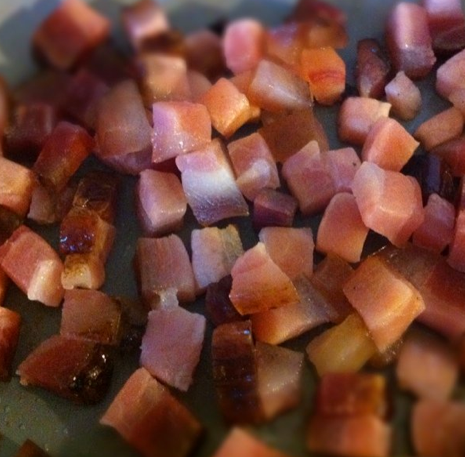
Pancetta-second best was still pretty good

The bad news starts with my use of plain old grocery store eggs (I am quite sure the hens did not forage for their own food nor were they supplemented with grains soaked in fresh goat milk).  It continues with a package of pre-cut pancetta (world’s apart from Paola Parisi’s guanciale, see below).

“Aside from being an exceptional slaughterhouse, Levoni is known for smoking meat, in this case the guanciale from Paolo’s pigs. The process requires a special machine, one resembling a rotisserie, and the burning of select woods (their type remains a secret). This slow curing takes a week to complete.”

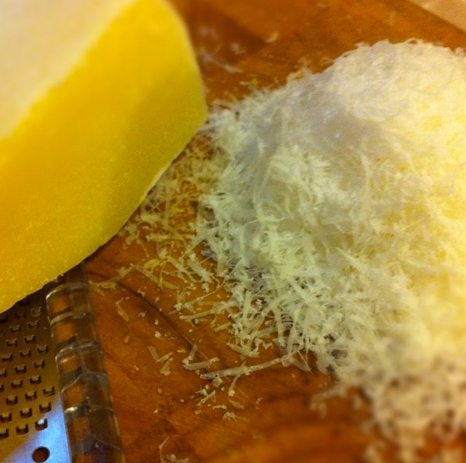
Grana Padano

I decided to use Grana Padano since I already had it.  In a large bowl I crack the non-fresh eggs, add fresh marjoram (from a plastic container), lemon zest, minced garlic and a “Jamie Oliver” glug of olive oil.  I make some quality tagliatelle from the pantry at home. Drain the pasta. I add this to the egg mixture, toss quickly and mix in the cheese. A little pasta water smoothes it all out. It’s steamy, glossy and fragrant as I bring the fork to my mouth.

sadly, not a farm in sight.

And yet it has none of the romance, practise or purity of Paolo’s version…..

“He starts by prying massive wedges from a wheel of Parmigiano-Reggiano cheese. He hands them to his second eldest son, Rocco, who quickly goes to work with a circular grater. I am handed a corkscrew and a bottle of 2006 Ansonica from the nearby La Parrina winery. Paolo collects the dish’s materie prime, arranges them on a massive wooden table and dices thick slabs of his guanciale picked up from Levoni the previous afternoon. He grates zest from a few lemons taken from a tree just beyond the kitchen window.”

The true dish must be heavenly because even my industrial version– merely a shadow in Plato’s cave–was dreamy.  The nuance of the zingy lemon zest and grassy marjoram elevates the savoury, rich flavours.   And the whole thing comes together in the time it takes to boil pasta.

And raise a few hens.

Pasta Carbonara- adapted from Cucina Italina  (at Sam’s request!)

serves 4

The key to this recipe are the eggs.  With Farmer’s Markets opening up soon it should be easier to get fresh ones. I did use “what was in the fridge” with good results.  You can fiddle with this recipe, assume 1 egg per person and then roughly adjust the other ingredients.  I am often a nightmare without detailed guidance but it worked to “eyeball” it.

And for God’s sake–please–use real Parmigiano Reggiano.

4 fresh eggs, large

2 cloves garlic, minced very fine

3 tbsp (45 ml)  fresh marjoram leaves, pulled off the stem

zest of 1 lemon

1/4 c  (60 ml) olive oil

1 cup (250 ml) pancetta, small dice

1 lb (500 g) spaghetti ( I like Rustichella d’abruzzo, fairly easy to find, brown paper package)

1 1/2 c (375 ml) Parmigiano Reggiano (or Grana Padano), freshly grated

1. In a bowl large enough to hold the spaghetti crack the eggs, add garlic, marjoram, lemon zest and olive oil.  Whisk to combine and set aside.

2. Pan-fry your pancetta til getting crispy.  Let cool and add to the egg mixture.

3. Boil pasta, salt water generously (should taste like the sea I’ve been told!). Cook spaghetti til al dente or as per package directions. Strain and reserve 1/2 cup pasta water.

4. Add hot pasta to the egg mixture and toss until well coated.  Add the grated cheese and keep tossing until you have a glossy sauce.  Add a little bit of pasta water as necessary to thin.

5. Eat the damn thing!  (Add fresh ground pepper if you like.)

NOTE FROM SELF:  I use slightly less spaghetti for four as I like a bit more sauce-maybe 3/4 package? 4/5ths?   6/8ths?  Someone stop me…..

12 Comments

Filed under All Recipes, Cookbooks, Magazines (+recipes from), Ruminations on the Edible

It’s Sandwich Day!

Immediate Impulse Buy

I unknowingly woke up into sandwich day.  It started when I was walking by a store window where the new Saveur magazine was on display.   Saveur is probably my favourite food magazine–I love the feeling that if I read a full years subscription I would be the savviest foodie on the block. I haven’t yet subscribed because I fear a pile up of unread issues will trigger massive foodie-anxiety.  (Only a subscription to The New Yorker is more terrifying in potentially magnifying my ignorance….of everything.)

BTW Canadians–the last issue had a great piece on Quebec and the maple syrup tradition (The Sweet Life) by Sasha Chapman.  And the sap is now running so get out there and lick it up.

Memories of my old sandwich stomping ground

Back to sandwich serendipity:  on my way home I stumbled across the Yorkville Sandwich Box location.  I have not eaten at Sandwich Box since it was a little store inside a strange little food strip at McCaul and Queen.  But man–the memories!   Grilled, hot, crispy, gooey, savoury, sweet, grilled, spicy…..oh the land of sandwiches.  I went with white panini  (sometimes whole grain is not the right choice) smoky grilled eggplant, crisp pancetta, bocconcini and curried apple spread.  I think I ripped the box in my excitement to get to the food.  And as after any great sandwich, I simply felt…happy.

So sandwich it up today people!  It’s meant to be.

Leave a comment

Filed under Cookbooks, Magazines (+recipes from), Restaurants and Products

You and Your Stupid pie crust Mario Batali

Stupid Lemon Tart with Gooseberries

“You are such a jerk,” I yelled out at Mario Batali’s cookbook photo (but with more use of the word asshole)  as the almond crust dough from his lemon tart recipe crumbled in my hands.  I actually love this recipe for its lemon filling.  It’s like making a lemon curd but then you lighten in with whipped egg whites. But whenever I go to make it I have that little “itch” in the back of my mind reminding me that something is going to make me livid.   For one thing, the quantity of crust is way too big for the 9″ tart pan (in my opinion) and secondly, it never comes together–if you x-rayed this dessert-you’d find a patchwork quilt of dough pieces which would mirror the fragmented state of my pie sanity.

And what’s up with ambiguous instructions like, “the juice of three lemons”?  Big lemons, little lemons?   I guess he means “just right” lemons.   Sorry.  This pie crust makes me angry.  It’s not the lemons, it’s me.

2 Comments

Filed under All Recipes, Cookbooks, Magazines (+recipes from), Ruminations on the Edible

I need a smoke (pt2)

Smoked salmon, lemon mayo and limey-minty-cucumbery salad

So it’s not wild salmon season yet.  Right.  I was so excited about the smoking portion of the experiment that I did not think of the fact that I wouldn’t be able to get wild salmon at this time of year (what goodness is there in life before May?).  I wanted the rich flavour you get from wild salmon so ended up with frozen (sustainably caught) sockeye  filets.

In the end I couldn’t get the smoking done Friday as I was already squeezed for time (which now  included defrosting).  Since I’d already built up anticipation levels previously reserved for Momofuku‘s arrival in Toronto it seemed best not to rush.  Do it right.  Or screw it up with plenty of time.

So here’s how it went down:

Earl Grey tea, muscovado and caster sugar smoking mixture

Saturday:

8:00 am: mixed the muscovado (dark brown) sugar, caster sugar and Earl Gray tea together.  Handily constructed two little trays from tin foil and divided up the mixture between them.  My estimate of what was “7-8 cm” wide was actually more like 13 cm.  Luckily tin foil is very squashable.

8:43 am  so many things could go wrong. Like that aside from no extractor hood, I don’t have a “tight-fitting lid” for my smoking dish.  Am going with the heavy-duty tinfoil.  Like duct tape in the cooking world, right?

Sockeye Salmon ready for a smoke

8:45  unplugged smoke detector and opened all the windows.  Put salmon on rack in roasting pan.  Covered the roasting pan and put it across two burners over med-high.  Stood there watching it.  Nothing happened.

8:55 10 minutes later the smell of caramelizing sugar and bergamot from the tea was wafting through the kitchen.  It was really lovely and mellow–I almost closed the windows to seal it in. (I could totally see “tea-smoked ” as a Body Shop perfume)

8:58  Conundrum. The recipe is broken into two parts: the general “how to” tea smoke section and then the recipe for the salmon specifically. In the salmon recipe it says to leave the salmon smoking for 3 minutes with the heat on and then turn off the heat and leave it another 3-4 minutes. Yet, as the “how to” instructions mentioned, it took about 10 minutes for the smoke to get going and begin infusing the fish.  So I was a bit confused–do the 3 minutes start after the 10 minutes?

I ended up doing two batches so as not to crowd the pan.  The first one which I left the initial 10 minutes (then 3 minutes on heat, 3 minutes off) was a bit overdone for my taste and I kicked myself for not checking it sooner.  The second round I actually put in right after I took out the first batch, heat was off, I quickly put the cover (foil) back on and left it five minutes.  Checked it and let it cook a little more, til tender and flaky.  Much better results.

Salmon under smoke tent-Round 2

The “being smoked out of house and home”  I was so prepared for never transpired.  In fact, all went very smoothly.  I admit, slightly disappointing.   I thought this post would be more dramatic with at least one neighbor coming over to see if we were OK.

I removed the salmon and let it cool.  The smoky tea flavour was there,  subtle and delicate–the wild salmon itself was amazing.

I will do this again and next time I think I will try letting the smoking pan heat up for 10 minutes before I add the salmon so that the fish is really being “smoked” rather than just cooked from the initial  trapped heat.

I served the salmon flaked and made lemon mayonnaise to go with it and an amazingly fresh, lime/mint/cilantro cucumber salad (Skye Gyngell’s recipe again).  Plus baguette.

(I kept a piece of salmon whole for the top photo.)

***Next time I promise kitchen disaster it will be bad, very bad.  I will make up for this.

Leave a comment

Filed under All Recipes, Cookbooks, Magazines (+recipes from), Ruminations on the Edible

Prepare to be smoked, Mr. Salmon

Smokin' Earl Grey-hoping not to inhale

Dinner Party this Saturday, April 2.

Have decided to tea-smoke salmon.  Partly because I have been dying to try it for years.  And partly because saying to my guests, “Oh, the salmon?  I just tea-smoked it.” seems so satisfying.  Even as I  say it to myself in my head it sounds good.  I imagine myself replying, “My you’re a talented cook!” Then I wink at myself, “Also,  your hair has great volume!”

Anyway, the recipe is from Skye Gyngell’s first cookbook “A Year in my Kitchen”.  And tea smoking is a technique the chef likes to use for oily fish (like trout, mackerel or wild salmon).  Essentially you need a baking vessel with a lid, a cooling rack, some ramekins (to balance the rack on) and a few tinfoil cups to put the tea –which you mix with sugar– in.  Then you place your fish on the rack, tea underneath, cover the fish and heat the whole thing over med-high on top of the stove, over two burners.

Not so hard, right?  But wait…more than once the words “extractor fan” are mentioned in this process.  I have no stove hood, no extractor fan but I do have a fire extinguisher in the kitchen, though I am not sure how that helps me if I’m dying of smoke inhalation.  At least when the firemen check the house they’ll be able to say, “yep, she had a fire extinguisher, too bad there wasn’t a fire–also, the salmon’s ready.”

Ah well, I’m being pessimistic, I can’t say for sure there won’t be a fire.

I’ll keep you posted.  I’m going to smoke the salmon Friday.  That way the dinner guests can make other plans if things should go awry.  No one can say I’m not a thoughtful hostess.

2 Comments

Filed under All Recipes, Cookbooks, Magazines (+recipes from), Ruminations on the Edible

East Side Mario’s Helps Girl Confront Kale Phobia

Italian Wedding Soup at home

I know it might not seem auspicious to begin a newly minted food blog with a rave review for the restaurant chain, East Side Mario’s, but I won’t deny any lip-smacking food and I’m telling you right now that the Italian Wedding Soup that came free (free!) with my main course at East Side Mario’s last week was deee-lish.  Replace the slightly overcooked Acini di Pepe (peppercorn shaped pasta) with something a little more al dente, then pop that bowl onto a white tablecloth (or reclaimed wood slab) and any fine-dining restaurant would  be $12 richer faster than you can say “Budda boom, Budda bing”.

OK, so I realize that Italian wedding soup is an ‘American-Italian” creation.  I did a little double checking to make sure–nope, couldn’t find it anywhere in The Silver Spoon cookbook (bible of authentic Italian cooking that it is) even though they do feature recipes such as “Farmhouse Rainbow Pie” (which I think suffered somewhat in the translation) and sounds like it should definitely be served at an East Side Mario’s somewhere out there–alongside Pot o’ Gold Penne.  But to the point: essentially the soup is a broth with tiny meatballs, spinach and pasta. Wedding soup is actually an incorrect translation of minestra maritata (married soup) implying that the veg and meat go well together.

ANYWAY, though I enjoyed the restaurant version of the soup, I did feel that I could make it with slightly less salt and additives– and whatever else that made it taste so friggin’ good at the “Mario”– at home. So I did a little internet searching and combined two recipes.  One is from Giada De Laurentiis, it’s pretty straight ahead, the meatballs were good and I liked the addition of the egg and parmesan at the end.  The other tip I stole from Susan Sampson.  In her recipe she cooks the meatballs and pasta each separately in boiling water before adding them to the broth so the broth doesn’t get cloudy.  Which made a lot of sense to me before I started and as I watched the scum accumulate from my boiling meatballs while they cooked.  The recipe makes a big batch, I made big meatballs, and we ate it all up in a couple of days.

The soup was so yummy that it occurred to me that instead of adding spinach to the hot broth, maybe the flavourful liquid could mask the taste of hideous kale.  Kale is my frenemy.  I love the smug feeling of good health and sound meal-planning I exude while kale is in my shopping cart, but don’ like its defiance once at home and the way it endlessly pops out of the crisper no matter how much I try to shove it to the bottom.  I just don’t like the taste.  I’ve tried to braise it and sauté it and I have yet to chop it up very tiny and put it into lasagna (which was my next plan of attack).  Because it is SO HEALTHY, right?

So I gave it a go in the soup.

It was the beginning of a beautiful friendship (or should I say marriage?).   Thank you East Side Mario’s, you helped me kick kale’s ass.  Or at least boil it.

8 Comments

Filed under All Recipes, Cookbooks, Magazines (+recipes from), Ruminations on the Edible