Category Archives: Ruminations on the Edible

Food inspired writing

Camping = Bacon

Yes, we just threw 2 packs into the pan. Bacon loves company.

Sometimes processed food is OK.  More than OK.  Perfect in fact.  Between this and the sour cream and onion crinkle chips.  I was feeling alright.

Don’t tell me your mouth is not watering just a little bit.

Let me inspire you:

*Bacon and ripe August tomato sandwich (with mayo)

*Bacon and scallops

*Bacon and peas

*Deviled eggs with crispy bacon

*Crisp Salad, blue cheese dressing, bacon

*Bacon in Meatloaf

*Bacon Cheeseburger

*Bacon and caramelized onion quiche

*Roasted Brussel Sprouts and Bacon

*Bacon in your hand at the kitchen counter before the eggs are finished

2 Comments

Filed under Ruminations on the Edible, Travel and Food, Uncategorized

So Many Damn Peaches

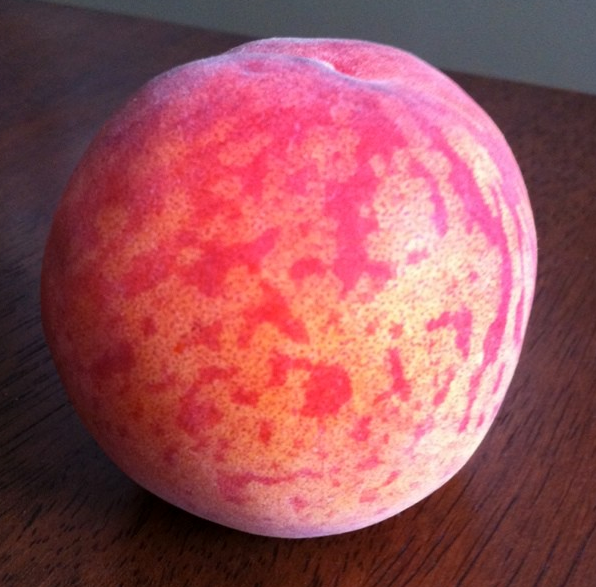
Planet Peach

Summer peaches.  A perfectly ripe, juicy, pain in the ass.

Why do I have to buy a whole basket of peaches?  Why can’t I buy just two or three at the farmer’s market?

Because none of the farmer’s want to deal with all those damn peaches either. “Take them urban consumers!” they shout at us. (In their heads.)

So my perfect peaches sit on the counter while  fruit flies circle and I shove slice after slice into my mouth like some uber-healthy, hot dog eating contest for the “eat local” movement.  At which point I’ve only eaten 2 1/2 peaches.

Ready for the sauce.

So how do I rescue my delicate bounty from the fate of the green bin?

Luckily, Delmonte comes to the rescue.  Peaches in syrup.  AHA!

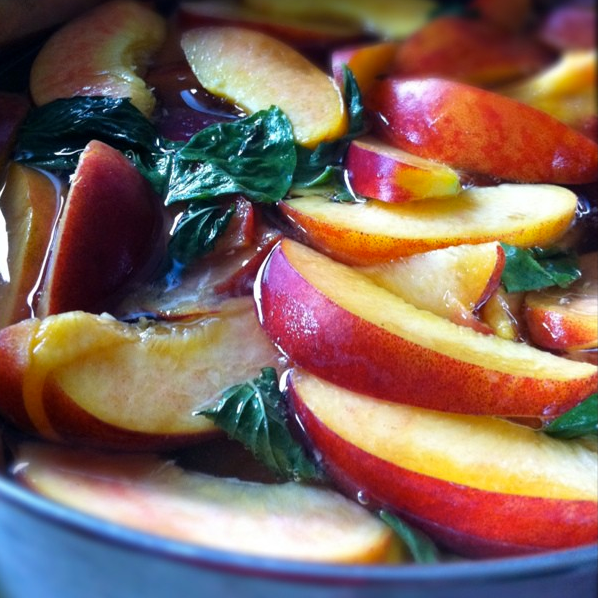
I slice eight peaches.  I make a light syrup in a medium pot.  (4 cups water, 2 cups sugar).

Once the sugar has dissolved I add the peaches and some mint and basil leaves (my basil plant weeps with gratitude at its usefulness–the poor thing barely sprouts a leaf under my care.)

A peach of a plan.

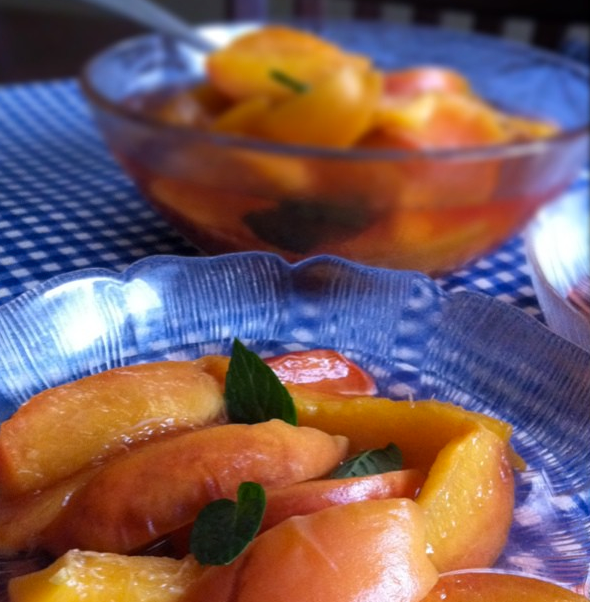
And then I bring it all up to a simmer, pour in a shot of Triple Sec (from my margarita stash) and pull it off the stove.  Let cool and store in the fridge so you can eat them all week. On top of ice cream!  YES.

Don’t be distracted by the above picture, keep your focus on the fact that the herby-fresh syrup created from our peachy compote is great for cocktails.  Like peach infused Mojitos.

The  minty, aromatic liquid is a perfect sweetener for the limey-tart concoction.  Mash some of the fruit in there too.  God knows you have to use it up somehow.

4 Comments

Filed under All Recipes, Cookbooks, Magazines (+recipes from), Ruminations on the Edible

Pickles in Heat

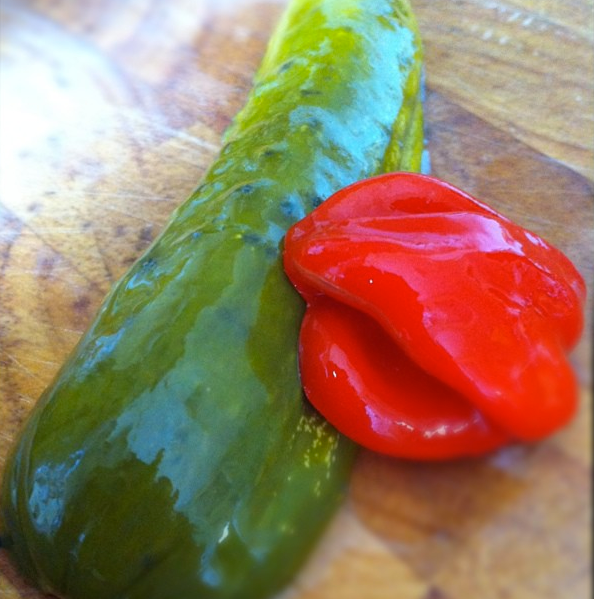
The website has pickle recipes. Beat that cucumbers.

The McClure’s pickles website has recipes for pickle brine.  Beat that cucumbers!

Word of caution: Put a warning Post-It on these  when you plop them in the fridge.  My husband took a big bite before squealing (like a pig) at their spicy nature.

Then Donna our babysitter innocently gave one to my son Felix.    So I pretty much burned the whole household.

OK, this photo gets weirder the more I look at it.

Even at All the Best Fine Foods (have you been there since they re-opened in their reno-ed building?  You’ll be lost in wonder) I was kindly warned twice about them before I took a bite.

But the fact is-they’re delicious!  And honestly, I am pretty flimsy when it comes to spicy food.  Yes, they’re hot but they have so much flavour that you persevere.

(And truthfully–Tad and Felix–bunch of wimps!)

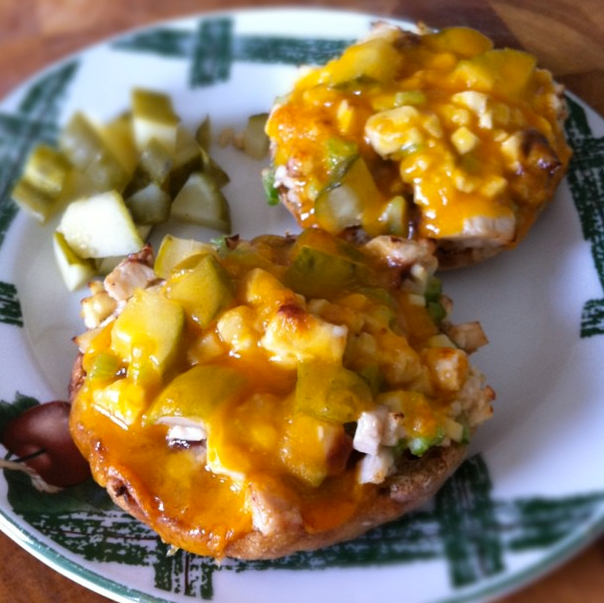
If you do want to temper their bite try them in a sandwich and they’re amazing with melted cheese.  Like my retro chicken salad melt.

Pickles inside and out.

Spicy pickles are also a fine option to sneak into your mild-mannered enemy’s lunch bag.  Except once they’ve had these they’ll probably want to be your friend.  I warned you.

1 Comment

Filed under Restaurants and Products, Ruminations on the Edible

Tarte Tatin is like a pearl necklace (A Haiku)

You had me at caramelized.

Simple and elegant is what I meant about the pearl necklace in case “cheap and chipped” initially popped to mind.

I made a Tarte Tatin to serve post-BBQ on Saturday night.  It truly is one of my favourite desserts.   The apples were sticky and rich with a touch of burnt caramel bitterness.  And we loaded on big spoonfuls of real whipped cream.

I recommend making way more whipped cream than is sensible so you can eat the leftovers from the same bowl you served it to your guests in.  Meanwhile they look on aghast, wishing you would stop stuffing your face and ask if they want a coffee.

To which I say in my defense,  Isn’t a f’#@!%#  homemade pie enough????

Anyway, eh um….

TARTE TATIN IS LIKE A PEARL NECKLACE

Simple elegance

Induces feeding frenzy

My pearls are trashed

6 Comments

Filed under Food Haiku, Ruminations on the Edible, Uncategorized

Toast Post: Tiger Blue

Buttery, fierce Tiger Blue with ginger/apple/pear chutney.

Does it work with Zinfandel?  Depends who you ask.  If you ask the cheese, then yes. If you asked the Zinfandel, well, wine won’t answer you. It talks with its eyes.

I recently had Tiger Blue at a wine tasting and realized I had forgotten how addictive it was.

Tiger blue is a spicy, roar of a cheese and it won’t work for everyone.  It’s also very smooth, rich and creamy and I find that just as the blue-lover in me is begging for mercy I’m hit with buttery richness that soothes my panicking taste buds.

You’ll see that in this case I added a smear of apple/pear/ginger chutney courtesy of Nick at Olympic cheese (have you seen the stores’ makeover?).

And BTW, even if you don’t eat this cheese it just looks unbelievable on a cheese board.  Like a cool piece of marble.  It watches you and thinks, “Hey Matey,  (I know! The pirate voice is so unexpected) why don’t you lurch on over here and slice a sliver off my cool, smooth wedge.   What’s that parrot?  Polly want a neutral cracker to cleanse the palate?

Tiger Blue in 11 words or more:  Producer is Poplar Grove in British Columbia (Naramata Bench, Okanagan Valley).  This cheese will change over the seasons depending on the cow’s milk, it may be more creamy or it may be more crumbly.  Made in the style of Stilton. Comes in a 2Kg wheel.  Pasteurized and a must-try if you like blues.  Get it at Olympic Cheese if you hail from Toronto….

3 Comments

Filed under Cheese/Cheese Related, Ruminations on the Edible, Toast Posts

Thanks for the ribs Pete Watson

Man, my camera was so sticky.

Nothing grilled, nothing gained as they say.  Five years after Pete Watson and his wife Lara gave us a Weber kettle grill for a wedding gift we finally made ribs on it. What idiots we were to deny ourselves the pleasures of grilling ribs on charcoal for sheer procrastination.

But we have gained, oh yes, we have gained.  Sticky fingers, kind of sexy, smoky smelling hair and the most envious aroma of deliciousness coming from any backyard in the neighborhood.   If only I had begun the process in the early afternoon as I declared I would, we could have actually had the ribs for dinner rather than the cold pizza we half-heartedly choked down waiting until the ribs were fall-off-the-bone tender at 11pm.

Here is our talented little grill pre-show.

The kettle potential.

And then I bought myself some apple wood chips and though I could not get a coal chimney (sold out) I got some quick burning coal starter things which were quite effective as long I did not let my thought wander to the substances that made them so quick-burning.

My indirect heat set-up is almost ready.

I have the coals on one side and a drip-pan filled with water on the right.  I put a stainless steel box of soaked applewood chips on the coals just before I added the top grate and the the lid.

Ribs: rubbed, rested and ready.

Two racks of baby back ribs, about 2 lbs each.  I put a dry rub on them and left them for an hour at room temperature.  The rub had sweet paprika, onion powder, garlic powder, dry mustard, celery seed, fresh back pepper and chili powder.  The recipe (BBQ Back ribs with Sweet and Sticky Sauce) came from the Saveur BBQ Issue (I know, what else, right?  I will branch out one day but once again not only were the magazine’s recipes lipsmacking but the stories of BBQ, coleslaw, baked beans, coals, tradition and rivalry were addicitive too!)

And while the ribs cooked between 225 F-250 F over 3 hrs  ( I actually found it hard to keep the heat below 300 F even adjusting the vents as much as I could) I made the sauce.  Honey, apple cider vinegar, brown sugar, worcestershire, hot sauce, cloves……MMMMMMMMMMMMMMMessy.

Served with coleslaw and napkins.

And finally at 11pm, with the grill lit from the soft glow coming through the back door of the kitchen, I was able to pull off  shreds of the crispy rib-ends that were slowly caramelizing from their recent basting in sticky sauce.  And I ate them greedily, slightly out of site of my husband before he next opened the door to ask, “are they done yet?”.  And they were good.  Sigh with pleasure good.

Like Angelina Jolie, I am now a Pitt master.

And that’s why I want to thank you Pete Watson.

5 Comments

Filed under All Recipes, Blogs with cooking tips, Cookbooks, Magazines (+recipes from), Ruminations on the Edible, Uncategorized

Fougasse: White Bread Glee

Chewy Good Times

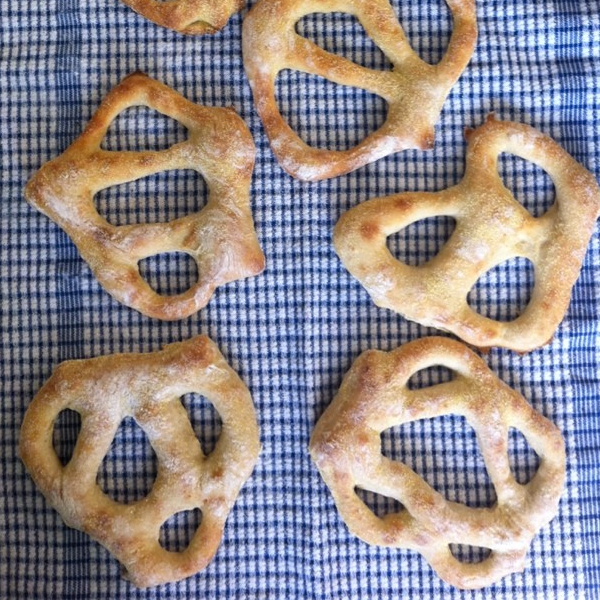
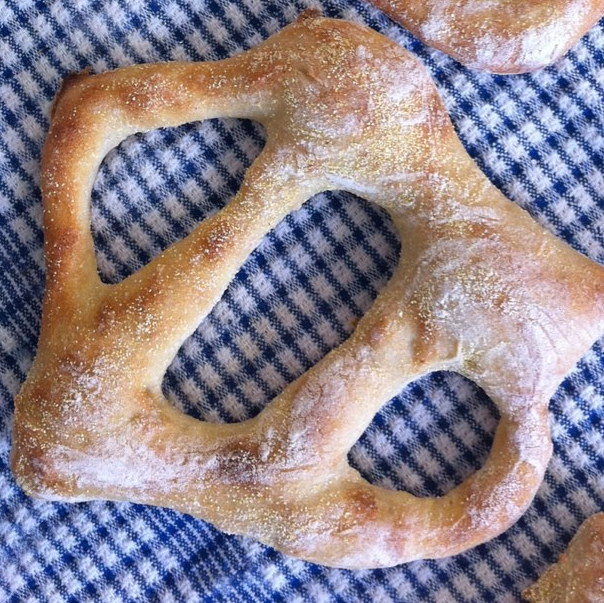
Easy. Impressive.  Can be hooked on the end of your bike handlebars.  These chewy, pretzel-like loaves are my new Gleedom.

I mean, look at them!  (let me show you an overhead.)

They multiply like rabbits, be careful.

The Fougasse first caught my attention in Dorie Greenspan’s Around My French Table where she explains that this Provencal-style bread should be eaten warm and with simple food,  like some saucisson and a glass of rosé.  Ideal for picnics.  And guess where I took mine?  On le picnic.  Man, sometimes my French instincts overwhelm me.

The recipe I actually used came from the book Dough by Richard Bertinet which has the Fougasse on the front cover. Most importantly in the book Mr. Bertinet said this was easy to make and would impress people.  Well, who am I if not someone who wants to impress with the least effort possible?

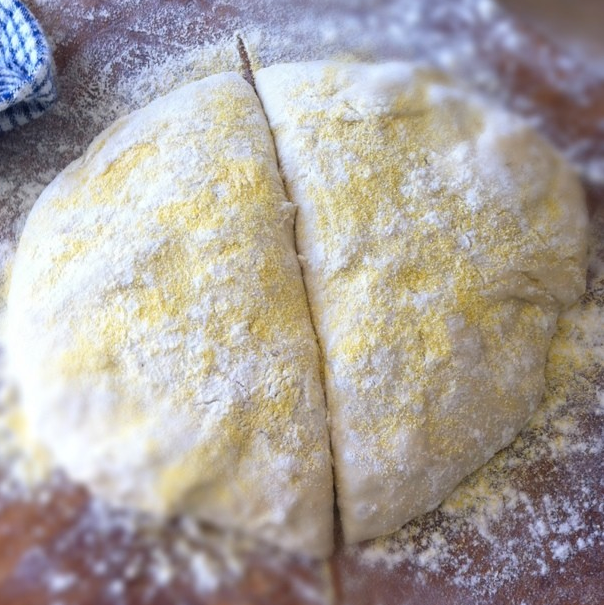
Cornmeal dusted dough

You start by making a simple white bread dough (yeast, bread flour, salt, water) and letting it rest for 1 hr until it doubles in size.  My dough took longer, maybe an hour and a half, perhaps the kitchen was a bit cool. Then you gently plop it on the counter-careful not to deflate it–and let it rest another five minutes.

Using your bread scraper you cut the dough in two (and giggle to yourself because it looks like a bum!).

And then into 6 pieces.

Baby Fougasse.

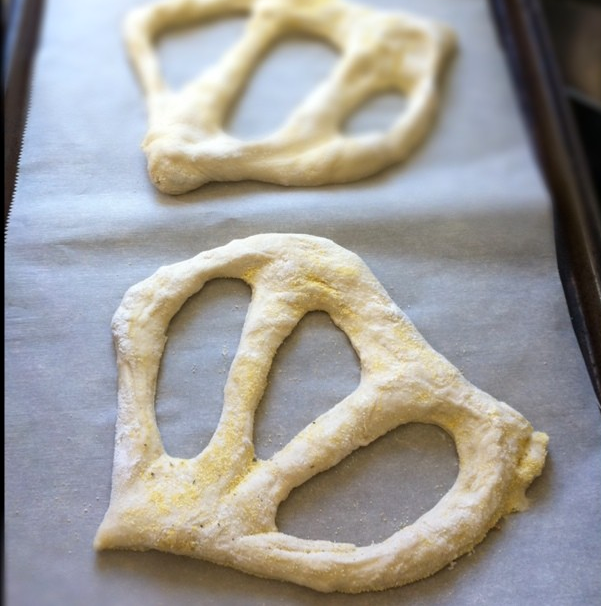
You then take each piece of dough and use the edge of your scraper to make a few diagonal cuts through the dough.  Which you then “fan out” with your fingers.

You Must Be My Lucky Star

You can also keep the dough rectangular and make parallel cuts and pull them apart to make a “ladder” shape.  Fewer holes are better because as the dough bakes any small holes will close up.  Obviously I am far (but pretty close) from being a master at this so I did most of my fougasse with only three cuts.

Ready for heat.

Now take your fougasse and pop them on a baking tray (or a wooden peel if you have one so you can slide it onto your baking stone already pre-heated in the oven 450 F).  I baked mine two at a time on a tray.  You can also press olives, or herbs into your fougasse at this point.

I did use a spray bottle to spritz some moisture into the oven before I shut the door to help get a nice crust on the bread (steam helps crust up the exterior and keep the interior soft).

Tear apart and eat.

Et Voila!  12 minutes later a delicious picnic snack.  Just wrap them in a clean tea towel and go.

(Would also work as tasteful accessories for a meat dress).

1 Comment

Filed under All Recipes, Cookbooks, Magazines (+recipes from), Ruminations on the Edible

Marion’s Fudge Recipe (lucky you!)

This is Marion...

And this is her wonderful fudge recipe.

(Check out step-by-step photos and the story behind the 70 year old recipe)

MARION’S FUDGE RECIPE  (adapted by Sue and Donna)

1 cup packed brown sugar

1 cup white sugar

6 tbsp Becel Margerine (4 tbsp if making chocolate fudge)

3/4 cup whipping cream (35%)

1 tsp vanilla

*2 ounces (2 squares) semi-sweet chocolate only for the chocolate fudge version

Instructions

1. Grease an 8″ X 8″ dish and set aside (mine is 9″ x 9″ and works fine, just makes thinner squares).

2. Have a medium bowl ready with 1 tsp vanilla already added.

2. Into a medium, heavy bottom pot add the brown and white sugar, the margarine, whipping cream (and chocolate, if making chocolate fudge)

3. Heat over high and stir to combine.  Let boil until a candy thermometer (or digital thermometer) reads 240 F. This will take about 10-12 minutes and means you have reached “soft ball” stage.

4. Pour the molten mixture into your medium bowl.  Using a hand mixer, mix on med-high (careful not to splatter as this is extremely hot) for about 1-2 minutes until the thin splatter on the side of the bowl starts to crystallize and gets dense when you wipe it with a finger…it will be “fudge-like”.

5. Pour the mixture into your 8″ X 8″ dish and allow to cool.  Slice and share.  (yah, right!)

** I cooled this in the fridge to speed things up the first time and found that slicing it when cold was harder as the fudge was more crumbly.

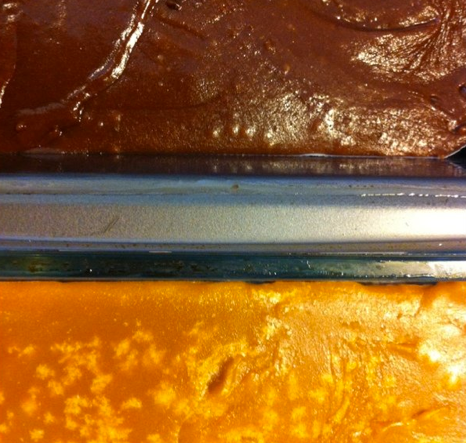
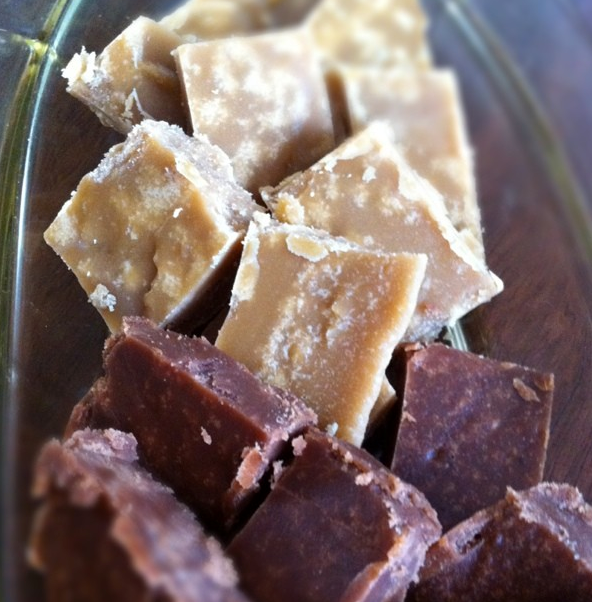
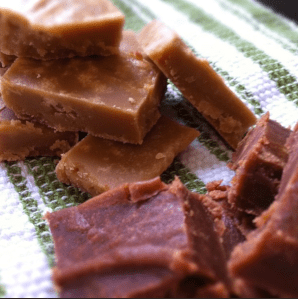
Chocolate and Vanilla so happy together.

5 Comments

Filed under All Recipes, Blogs with cooking tips, Ruminations on the Edible

Toast Post: Cottage Gold

Cottage Gold, sibling to Niagra Gold

It’s not my camera, it’s the Guernsey milk.  The cheese really is this intense colour.  All due to the elevated beta-carotene levels found in the milk of the Guernsey cow.  (It also has more protein and vitamin A and D than Holstein milk.)

Let’s stop picking on the Holstein and concentrate on the fact that this cheese is A. only here for the summer and B. the summer is not that long. (I’m being a pessimist like my mom, who on the first day of a long-awaited vacation will point out “well, it’ll all be over in 10 days– also there’s a lot of rain in the forecast.)

Cottage Gold is a cheddar-like version of Niagara Gold (an Oka-style cheese) made by Upper Canada Cheese, who are also known for Comfort Cream and the lip-smacking and grillable Guernsey Girl.  Cottage Gold is dense, salty and buttery with a pleasant earthiness at the   rind. Avoid the rind if you prefer but if sliced thinly the “earthy” quality appeals on the palate and evokes a real sense of the outdoors.

Today was my first time trying the Cottage Gold and I can already see it doing a heelside front flip on the wakeboard and then drying off with a threadbare “Florida: The Sunshine State!” towel obtained from a long-ago family drive to Daytona Beach.  Also I can see Cottage Gold reclined on a patio chair drinking a cold beer.  Actually, that’s me on the chair with a beer, and a slice of cheese.  Or maybe I’d melt it onto a burger or pack it with some pickle chips and apple slices for an afternoon outing to Snake Pond (childhood reference–insert any mucky, deliciously squishy-between-the-toes pond with frogs and dragonflies from your own youth).

Cottage Gold in 11 words or more:    The Guernsey cow breed, originally from the British Channel Island of the same name, was introduced to North America in the 19th century and officially imported to Canada by future prime minister Sir John Abbott in 1878.  If you’d like to know more, check out this informative review of Cottage Gold  by Stacey at A Taste of Cheese. I’m going to eat more cheese.

Leave a comment

Filed under Cheese/Cheese Related, Ruminations on the Edible, Toast Posts

No Way Your Grandma’s Fudge is Better Than This

I Want You to Want Me

This recipe is 70 years old.  And it comes from a friend of a friend,  specifically, my friend Donna’s friend Marion who is 85 and has been making fudge since she was 15 years old.  Donna brought a batch over one day, and I  thought, “fudge, I don’t really care for it”.   Little did I know it was the best fudge ever made on earth.

I finally (after several tupperware gifts of fudge) asked for the recipe.  Donna brought me a photocopy of Marion’s handwritten instructions with the caveat, “many people have asked, no one has succeeded in making it”.   As I went through the recipe the first time I realized why people were having so much trouble.  It was written in a “dash of this, a dollop of that” kind of way that  a WW II Codebreaker would have a hard time cracking.

After many gruelling fudge-making trials Donna and I nailed it.

Before STEP 1: Marion says the whole fudge making process takes about 12 minutes.  She will not answer the phone or be otherwise distracted during this critical time and recommends the same to other fudge-makers.  I timed it–she’s pretty dead on. Please put iPhone on vibrate.

STEP 1:

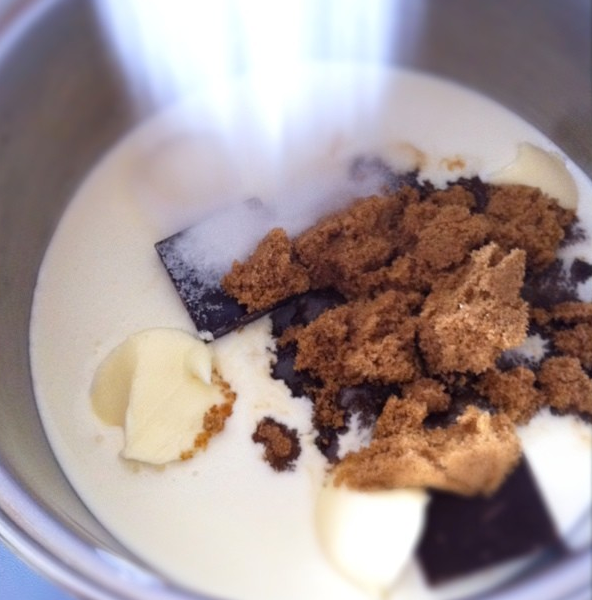
This is the chocolate fudge version. Brown Sugar, white sugar,  semi-sweet chocolate, cream and Becel margarine.

The basics of fudge.

The first time we tried this I carefully measured the Becel margarine (I contemplated using butter but do I really want to mess with a 70-year-old recipe?) using my measuring spoons.  Marion’s recipe said “4 tbsp.”   The fudge turned out OK, but not nearly as creamy as it should be.  I asked Donna to investigate.  She came back and told me that the spoon Marion uses as a “tablespoon” is huge.  I pulled out a soup spoon, “like this?” I asked.   “Bigger” Donna said.  I pulled out a serving spoon, and yep, hit the nail on the head.  So for the vanilla fudge I use 6 tbsp of Becel margarine and it works like a charm.  (4 tbsp seems OK for the chocolate as I think the chocolate adds creaminess).

Step 2:

You now bring all the ingredients to a boil in a medium-sized, heavy bottom pan.  You can stir them together as they melt.  You are waiting to heat the liquid to soft ball stage (235-245 F).
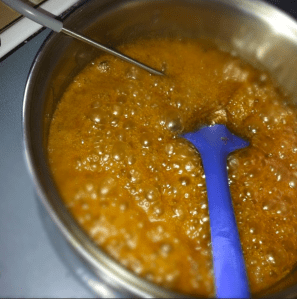
Waiting to reach soft ball stage.

Marion uses the eyeball technique to pinpoint “softball.”  You pull the mixture off the stove every once in a while and drop a globule into very cold water.  You then roll the droplet between your fingers in the water to form a soft ball  (which then flattens on your hand when removed from the water.)  It takes some practise to grasp what you’re looking for.

I nixed that technique.  If you’re not a pastry chef or a frequent baker I predict this will be the end of your fudge making.  Instead I grabbed the digital thermometer (a candy thermometer available at the grocery store is also fine) and pulled the mixture off the stove at  240 F.

Step 3:

This was the most mysterious part of Marion’s process.

Mix Master

The instructions read, “Pour mixture into your Mixmaster and beat on speed 11 for about 1 minute. Carefully watching.”  Watching for what?  Donna did not know either.  Secondly, I am pretty sure the Mixmaster only exists in Marion’s kitchen and the Julia Child kitchen at the Smithsonian (it has 11 speeds!).

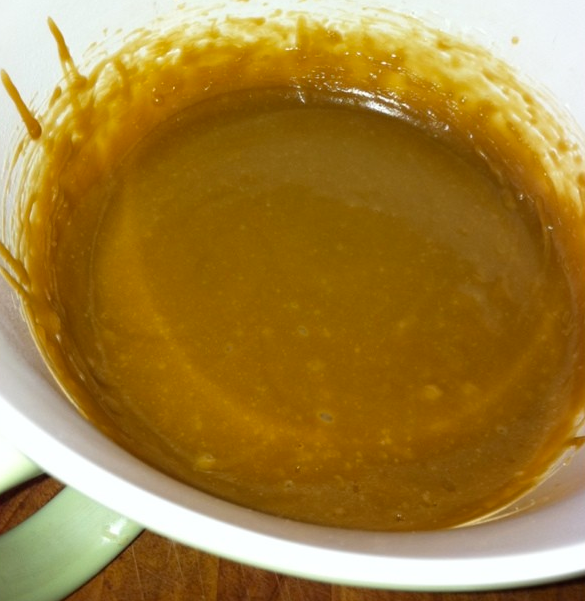
After careful watching

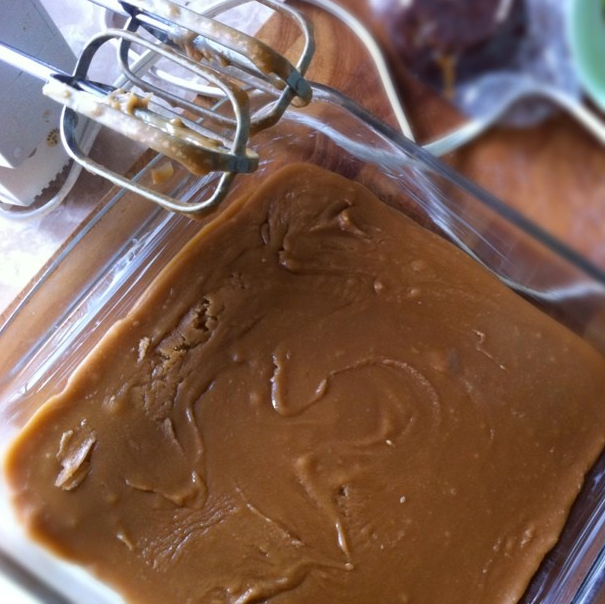
Instead of the Mixmaster I pulled out my electric beater and used that. Considering it is a hand-me down from my mom and its highest speed is as fast as the “low” speed on a new model, I figured it would work.  I poured in the hot fudge with a tsp vanilla and started beating.  And after about a minute I saw the splattered edges of the bowl start to crystallize–like the texture of fudge. Which I believe is what you’re “carefully watching”for.   So at that point I poured the thickening mixture into a 9″ X 9” greased dish.

Fudge settles in.

Step 4:

Allow to cool while you lick the bowl.  Slice and eat.  You win!  Your life is now the best it will ever be.

Oh boy.

Marion’s Fudge Recipe (Adapted for lesser mortals).

4 Comments

Filed under All Recipes, Blogs with cooking tips, Ruminations on the Edible